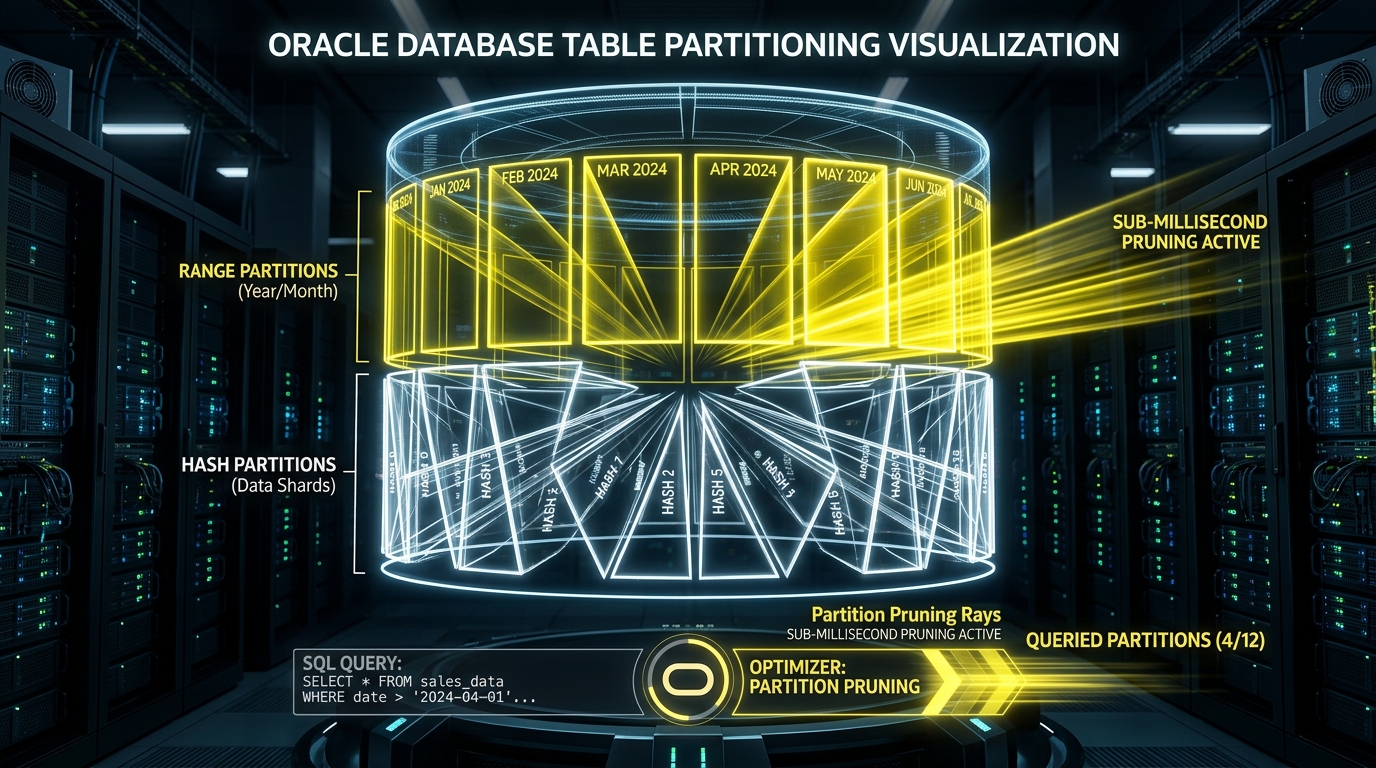
1. Slicing Petabyte Datasets: Core Partitioning Strategies
In enterprise transactional and analytical systems, tables often grow beyond billions of records. Partitioning allows a table or index to be physically subdivided into smaller, independent segments while maintaining a single, unified logical entity for applications.
The primary partitioning methods include:
An extension of Range partitioning where Oracle automatically creates new partitions on demand as new dates or values are inserted, eliminating DBA manual maintenance.
Primary partitioning by date range (lifecycle management) combined with secondary sub-partitioning by customer ID or hash (I/O striping and partition-wise joins).
-- High-Scale Composite Range-Hash Table Definition
CREATE TABLE ledger_transactions (
    txn_id        NUMBER GENERATED BY DEFAULT AS IDENTITY,
    account_id    NUMBER NOT NULL,
    txn_date      DATE NOT NULL,
    amount        NUMBER(12,2),
    region_code   VARCHAR2(10)
)
PARTITION BY RANGE (txn_date)
INTERVAL (NUMTOYMINTERVAL(1, 'MONTH'))
SUBPARTITION BY HASH (account_id) SUBPARTITIONS 16
(
    PARTITION p_init VALUES LESS THAN (TO_DATE('2026-01-01', 'YYYY-MM-DD'))
)
TABLESPACE tbs_data_2026;
2. Partition Pruning Forensics: Static vs. Dynamic Pruning
Partition Pruning is the single most powerful performance optimization enabled by partitioning. The Cost-Based Optimizer (CBO) analyzes WHERE clause predicates and eliminates non-relevant partitions from disk reads before I/O occurs.
- Static Pruning: Predicates contain literal constants known at compile time (e.g.,
WHERE txn_date >= DATE '2026-04-01'). The optimizer predetermines exactPSTARTandPSTOPvalues. - Dynamic Pruning: Predicates contain bind variables or subqueries (e.g.,
WHERE txn_date = :b1). Oracle evaluatesPSTARTandPSTOPat runtime, indicated byKEYorKEY(MC)in execution plans.
-- Execution Plan demonstrating Partition Pruning
SQL> EXPLAIN PLAN FOR SELECT SUM(amount) FROM ledger_transactions WHERE txn_date = TO_DATE('2026-04-15','YYYY-MM-DD');
-----------------------------------------------------------------------------------------------------
| Id  | Operation                   | Name                | Pstart| Pstop | Cost (%CPU)| Time     |
-----------------------------------------------------------------------------------------------------
|   0 | SELECT STATEMENT            |                     |       |       |    12   (0)| 00:00:01 |
|   1 |  SORT AGGREGATE             |                     |       |       |            |          |
|*  2 |   PARTITION RANGE SINGLE    |                     |     5 |     5 |    12   (0)| 00:00:01 |
|   3 |    PARTITION HASH ALL       |                     |     1 |    16 |    12   (0)| 00:00:01 |
|*  4 |     TABLE ACCESS STORAGE FULL| LEDGER_TRANSACTIONS|    65 |    80 |    12   (0)| 00:00:01 |
-----------------------------------------------------------------------------------------------------
Notice Pstart = 5 and Pstop = 5: out of 120 total partitions, Oracle scanned exactly 1 partition, reducing physical disk I/O by 99.1%.
3. Zero-Downtime Data Ingestion via Partition Exchange
Loading millions of rows into a high-concurrency production table causes intense table locks, undo overhead, and index rebuild delays. The EXCHANGE PARTITION operation swaps a standalone staging table directly into a target partition in under 5 milliseconds via a simple metadata pointer swap in the data dictionary.
INSERT /*+ APPEND */ INTO ledger_staging SELECT * FROM raw_external_stream;
-- 2. Swap staging table into partition p_2026_05 instantly
ALTER TABLE ledger_transactions EXCHANGE PARTITION p_2026_05
WITH TABLE ledger_staging INCLUDING INDEXES WITHOUT VALIDATION;
4. Global vs. Local Indexes & Asynchronous Maintenance
Choosing between Local and Global indexes governs both query performance and operational agility:
- Local Partitioned Indexes: One-to-one correspondence with base table partitions. Dropping or truncating a table partition automatically drops only the corresponding index partition without invalidating indexes across the rest of the table.
- Global Indexes: Index tree spans all partitions. Ideal for unique primary key lookups that do not contain the partition key.
- Asynchronous Maintenance: Starting in Oracle 12c and enhanced in 19c/23ai, adding
UPDATE GLOBAL INDEXESdrops partitions instantly while index cleanup is performed lazily in the background by thePMO_JOBcoordinator.
5. Partition-Wise Joins: Eliminating RAC Cache Fusion Pinging
When joining two large multi-gigabyte tables (e.g., Orders and Order_Items), if both tables are equi-partitioned on the identical join key (e.g., order_date or account_id), the Oracle Cost-Based Optimizer performs a Full Partition-Wise Join.
Oracle joins pair-wise partitions independently. In Oracle RAC clusters, each RAC instance processes local partition pairs in memory without transmitting blocks over the private interconnect, eliminating gc buffer busy contention entirely.