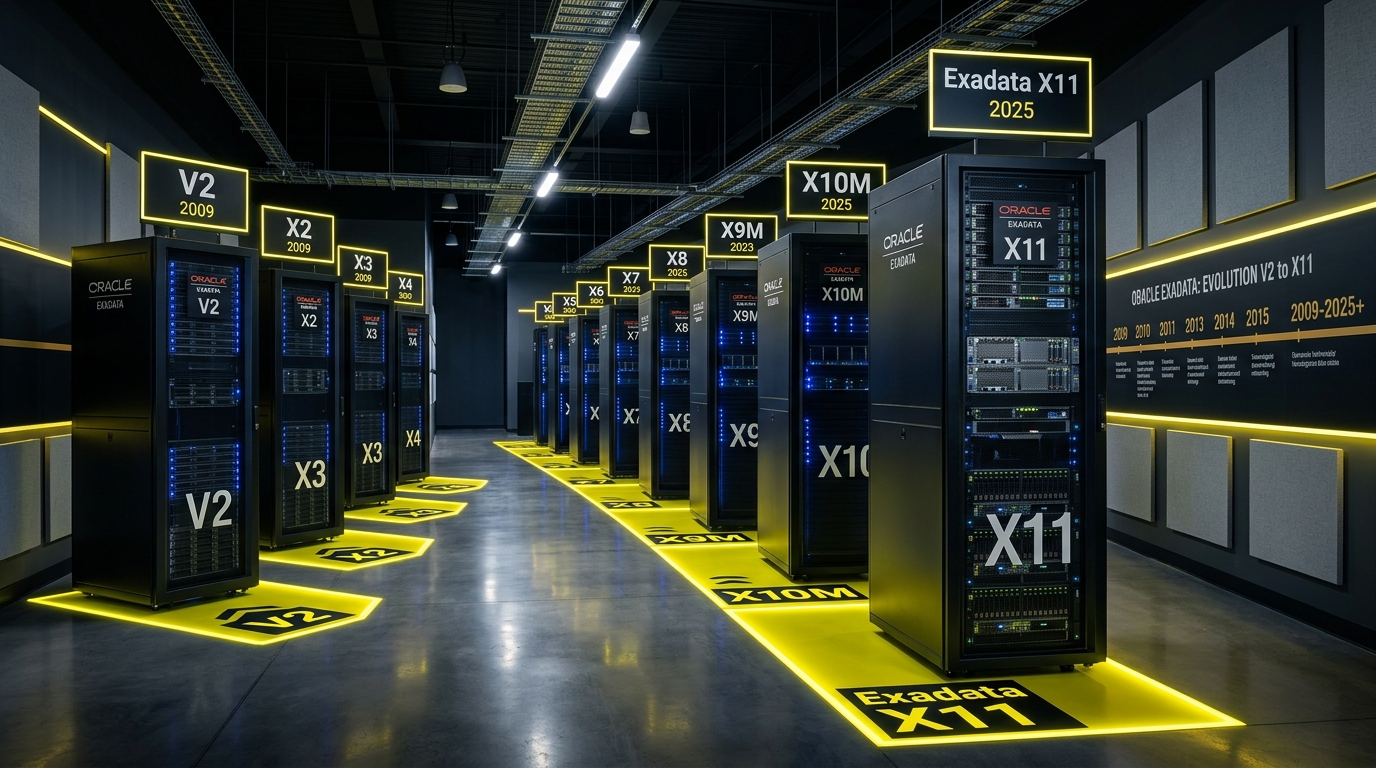
1. Two Decades of Engineered Systems Milestones
When Larry Ellison announced the Sun Oracle Exadata V2 in 2009, it introduced the concept of an engineered database appliance with PCI flash cards and Smart Scan software. Over eleven generations, Exadata transitioned from a niche data warehouse accelerator into the foundational platform for tier-1 global banking, telecom, and ERP workloads.
2. Generational Comparison Matrix: V2 to X11
| Generation | Year | Interconnect Fabric | Storage Media | Max IOPS (Full Rack) |
|---|---|---|---|---|
| Exadata V2 | 2009 | 20 Gbps QDR InfiniBand | SAS HDD + Sun Flash Accelerator | ~100,000 |
| Exadata X2 - X4 | 2010-13 | 40 Gbps QDR InfiniBand | SAS HDD + F40/F80 PCIe Flash | ~1,500,000 |
| Exadata X5 - X7 | 2015-17 | 40 Gbps InfiniBand | Extreme Flash (EF) NVMe SSDs | ~6,000,000 |
| Exadata X8M - X9M | 2019-21 | 100 Gbps RoCEv2 (RDMA) | Intel Optane PMEM + NVMe Flash | ~27,600,000 |
| Exadata X10M | 2023 | 100 Gbps RoCEv2 | AMD EPYC 96-core + PCIe 5.0 NVMe | ~60,000,000 |
| Exadata X11 | 2025-26 | 100/200 Gbps Ultra-RoCE | Gen-5 NVMe + AI Vector Engine | > 75,000,000 |
3. The Rise of Exadata Cloud@Customer & Autonomous Database
The latest evolution decouples hardware purchasing from enterprise adoption. Through ExaCC (Exadata Cloud@Customer), enterprises run sovereign, on-premises Exadata racks managed remotely via OCI cloud control planes, enjoying consumption-based billing and automated patching.