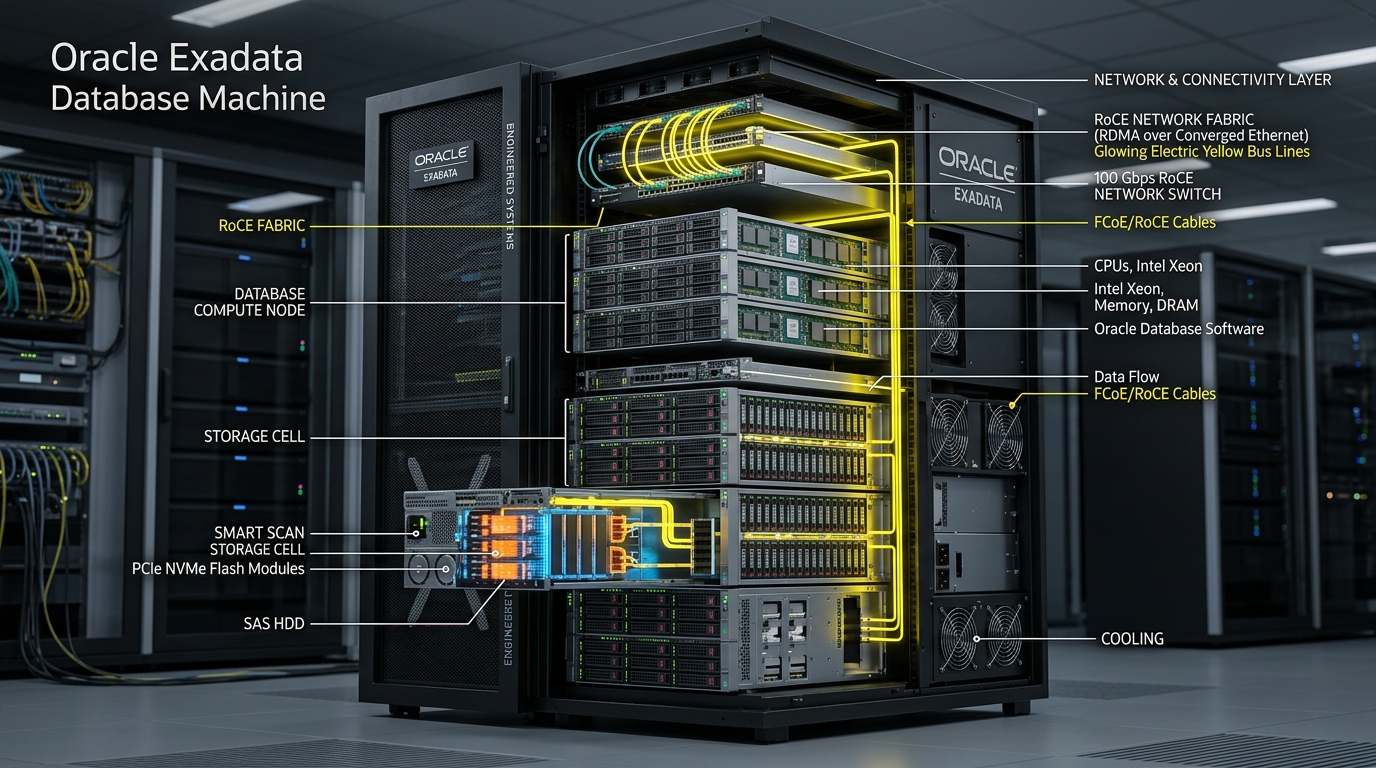
1. The Fundamental Storage Bottleneck in Enterprise Databases
In traditional SAN and NAS architectures, when a SQL query filters 1 billion rows to find 50 matches, all 1 billion rows must be formatted into 8KB Oracle blocks and piped across Fibre Channel or iSCSI networks to the database server. This creates severe network saturation and memory contention.
Oracle Exadata resolves this with an engineered hardware-software co-design: the database compute nodes delegate filtering and projection directly to dedicated, intelligent Exadata Storage Cells (Cell Servers).
2. Smart Scan Mechanics & Predicate Offloading
During a Smart Scan, the database process sends the SQL execution predicate and required column list across the RoCE fabric using the iDB (Intelligent Database) protocol. The Exadata Cell Server executes:
- Row Filtering: Evaluating WHERE clauses directly in storage cell CPUs.
- Column Projection: Discarding unreferenced columns from disk blocks before network transmission.
- Bloom Filters: Offloading hash join filtering to storage nodes during large analytical joins.
- Storage Indexes: Utilizing in-memory min/max summaries for 1MB storage regions to completely skip non-matching disk and flash reads.
-- Execution Plan identifying Smart Scan Offloading
SQL> EXPLAIN PLAN FOR SELECT SUM(txn_amount) FROM transactions WHERE txn_date > SYSDATE - 30;
-------------------------------------------------------------------------------------------
| Id  | Operation                   | Name         | Rows  | Bytes | Cost (%CPU)| Time     |
-------------------------------------------------------------------------------------------
|   0 | SELECT STATEMENT            |              |     1 |     8 |   420   (1)| 00:00:01 |
|   1 |  SORT AGGREGATE             |              |     1 |     8 |            |          |
|*  2 |   TABLE ACCESS STORAGE FULL | TRANSACTIONS |  4.2M |   32M |   420   (1)| 00:00:01 |
-------------------------------------------------------------------------------------------
Predicate Information (identified by operation id):
---------------------------------------------------
   2 - storage("TXN_DATE">SYSDATE@!-30)
       projection("TXN_AMOUNT")
3. RoCE Network Fabric: Sub-Millisecond RDMA
Modern Exadata generations (X8M, X9M, X10M, and X11) replace legacy InfiniBand with 100Gbps RDMA over Converged Ethernet (RoCEv2). RoCE allows database compute nodes to directly read Persistent Memory (PMEM) and NVMe Flash on storage cells without operating system interrupts or context switching.
4. CellCLI Storage Server Forensics & IORM
Enterprise administrators must verify that storage offloading is operating at peak efficiency using CellCLI commands:
CellCLI> LIST METRICCURRENT WHERE objectType = 'CELL' AND metricObjectName LIKE '.*IO.*'
CellCLI> ALTER IORMPLAN dbPlan=((name='PRD_OLTP', share=8), (name='RPT_BATCH', share=2))